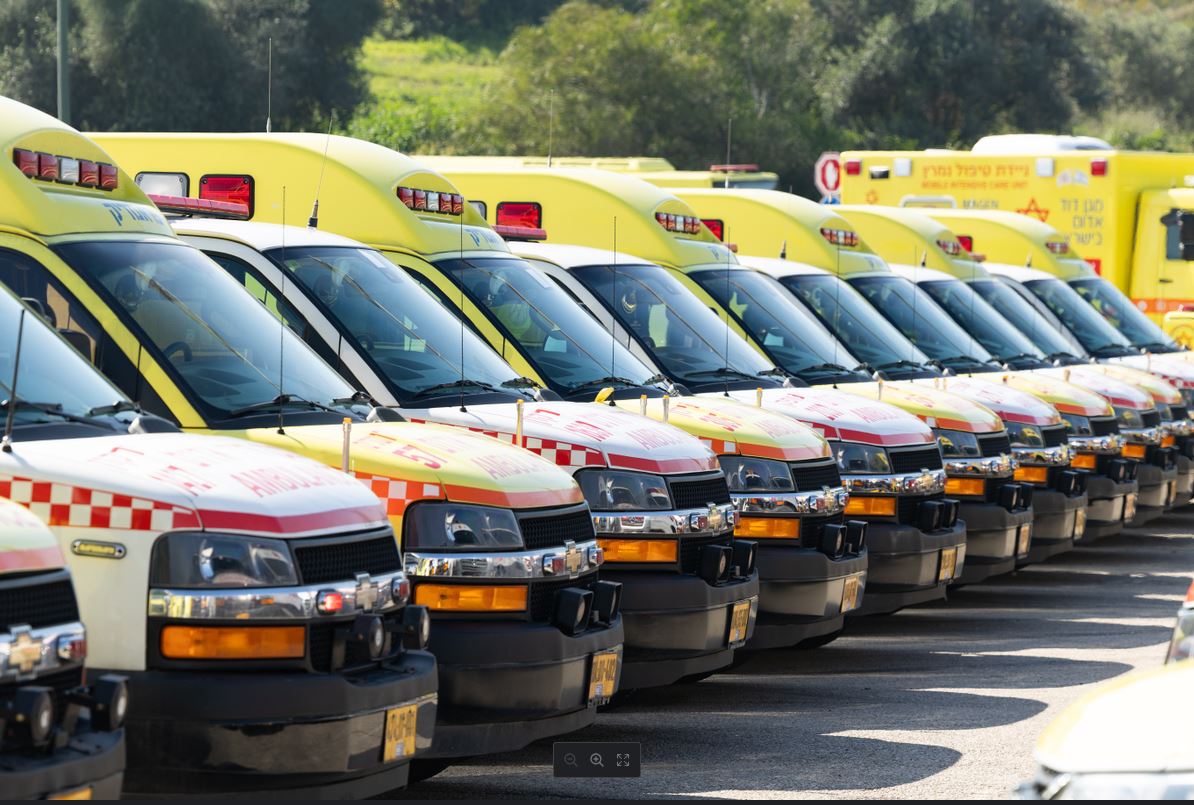


Rescue Vehicles in Magen David Adom
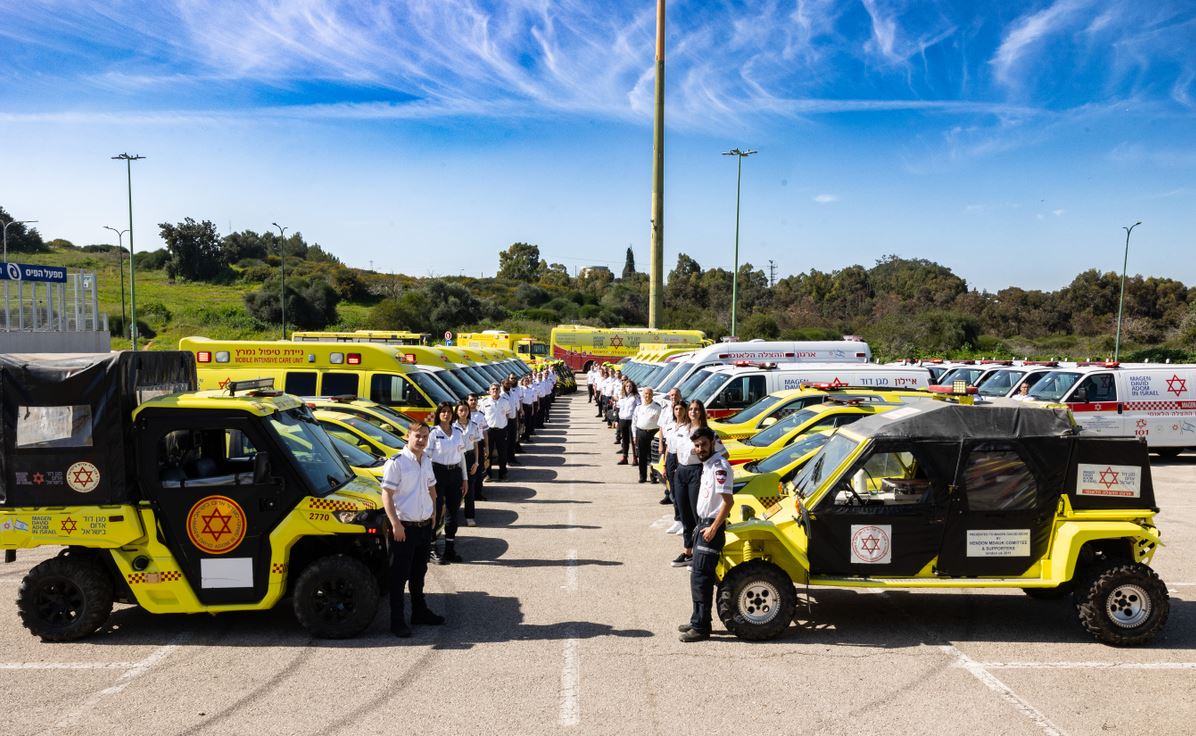
Advanced Life Support Services
The MDA fleet of medical vehicles is comprised of Mobile Advanced Life Support Units and Advanced Life Support Ambulances, Basic Life Support Ambulances, Mobile Mass Casualty Incident Units, Command and Control Vehicles, Ambulances equipped with 4 X 4 wheel drive, All Terrain Vehicle Ambulances, Helicopters, Segways, Advanced Life Support Motorcycles, First Responder bicycles, Rapid Response Vehicles, and a Supervisor Vehicle.
On each shift, several Mobile Intensive Care Units (MICUs) and Basic Life Support Ambulances are on duty, whereas the other emergency vehicles are at parked at the station, or with drivers who are on call duty, at home with the ambulances, serving as emergency personnel on call.
Mobile Advanced Life Support Unit
The MALSU crew is comprised of three functionaries: a paramedic, a physician and a driver who is also a medical emergency technician. The MALSU crew is usually accompany by an apprentice trainee or a volunteer.
The MALSU crew provides advanced life support in the field level. They are equipped with highly advanced equipment, including, among other things, a monitor, a defibrillator and ECG combined into a single device, and also some medications. Advanced medical procedures are performed in the MALSU. MALSUs are dispatched to handle serious incidents, such as a heart attacks, shortness of breath due to various reasons, harsh traffic accidents and various security related incidents.
Mobile Intensive Care Unit
The MICU is practically the MALSU without a physician on board. The MICU is equipped with the same equipment as the MALSU. The difference is that the MICU paramedic, who works according to the same protocols as in the MALSU, must, in some cases, obtain confirmation for some of the procedures from a physician who is on constant duty at the Integrated National Control Center.
The MICU crew is comprised of a driver, who is also an emergency medicine technician, and a paramedic. The MICU crew are usually accompanied by an apprentice trainee or a volunteer.
The MICU crew provides advanced life support in the field level. They are equipped with highly advanced equipment, including, among other things, a monitor, a defibrillator and ECG combined in a single device, and also some medications. Advanced medical procedures are performed in the MICU. MICUs are dispatched to handle serious incidents, such as a heart attacks, shortness of breath due to various reasons, harsh traffic accidents and various security related incidents.
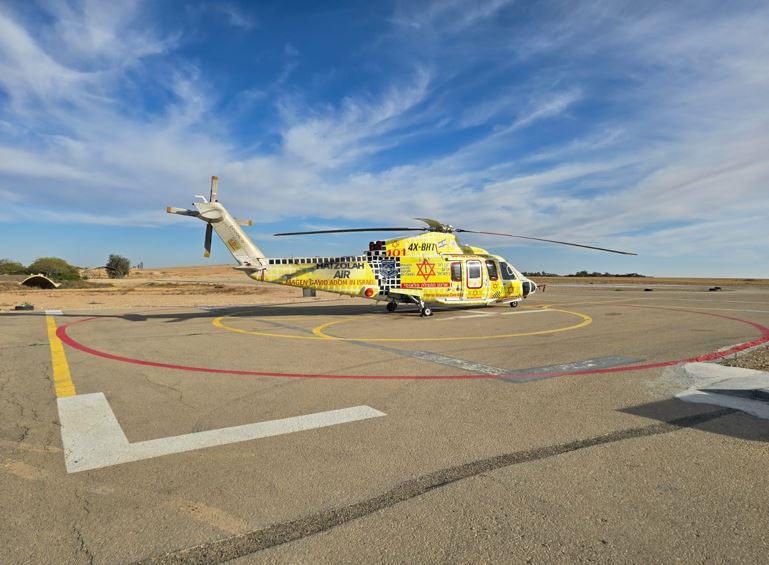
MDA Helicopter: Aeromedical Evacuation
In addition to dozens of MDA ambulances and MALSUs which make their way along Israel's roads daily, evacuating the wounded and the sick to hospitals, MDA also operates 5 MDA Helicopters designated for quick evacuation of the sick and the wounded from the periphery to central hospitals. The MDA Helicopter crew is comprised of three functionaries: a pilot and two paramedics who had additional trainings in aeromedical evacuation and treatment. The MDA Helicopter is equipped with 2 beds for patients / injured individuals. It is dispatched, when possible, on the same time as the ambulance, to the nearest landing pad, where the teams join, and from there the patient / ill / injured individual is flown to the hospital.
The MDA Helicopter crew provides advanced life support in the field level. They are equipped with highly advanced and sophisticated equipment designed for aeromedical evacuation and treatment, including, among other things, a defibrillator and ECG combined into a single device, and also some medications. Advanced medical procedures are performed in the MDA Helicopter. MDA Helicopters are dispatched to handle serious incidents, such as a heart attacks, shortness of breath due to various reasons, harsh traffic accidents and various security related incidents.
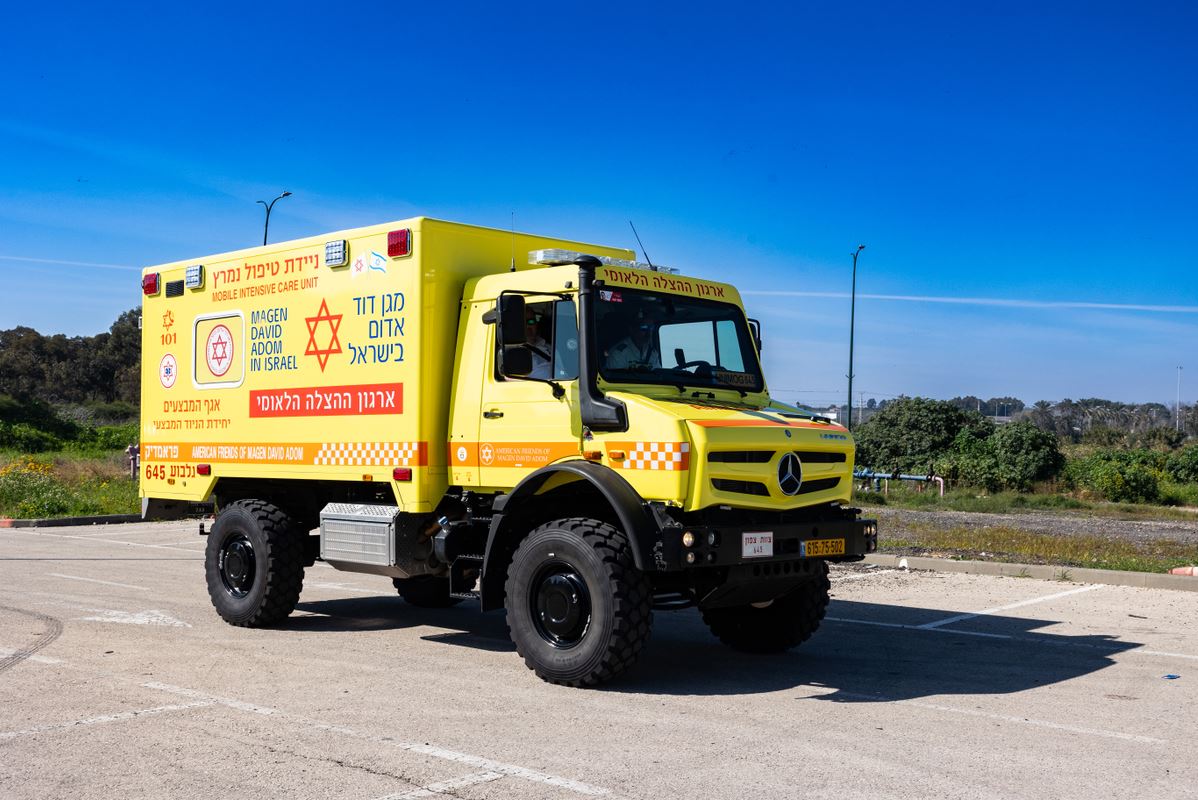
Command and Control Vehicle
This modern Command and Control Vehicle is used for command and control during incidents and for medical aid in complex situations. The vehicle is operated by a MDA supervisor who arrives in cases where medical reinforcement is required, or where road conditions require a 4 x 4 vehicle. The vehicle, one of only 3 vehicles of its kind in Israel, is installed and equipped to assist in handling exceptional emergencies. The vehicle is a 4 wheel drive Jeep, equipped with state-of-the-art equipment which includes a telescopic arm with spotlights, to facilitate the handling of an incident after dark. On board of the vehicle there is a special camera which can be remotely controlled from the Center of Operations and which helps the Control Center in handling a mass casualty incident, enabling personnel to obtain a fine view of the situation. The medical supplies in the vehicle are ALS level equipment, on a similar level of MALSU equipment. The Command and Control Vehicle also includes the option to evacuate a single patient in prone position. This option is helpful during routine times.
Tomcar
This new Tomcar ATV is equipped with two stretchers on board. The Tomcar is kept on call duty at the station and dispatched to incidents where it is necessary to evacuate injured individuals from an area that cannot be accessed by a standard ambulance (such as the seaside, an unpaved road, narrow passages).
The Tomcar is operated by a Magen David Adom paramedic who is qualified for this task. The Tomcar arrives to incidents where there is a need for ALS level of medical reinforcement or where necessary due to road conditions.
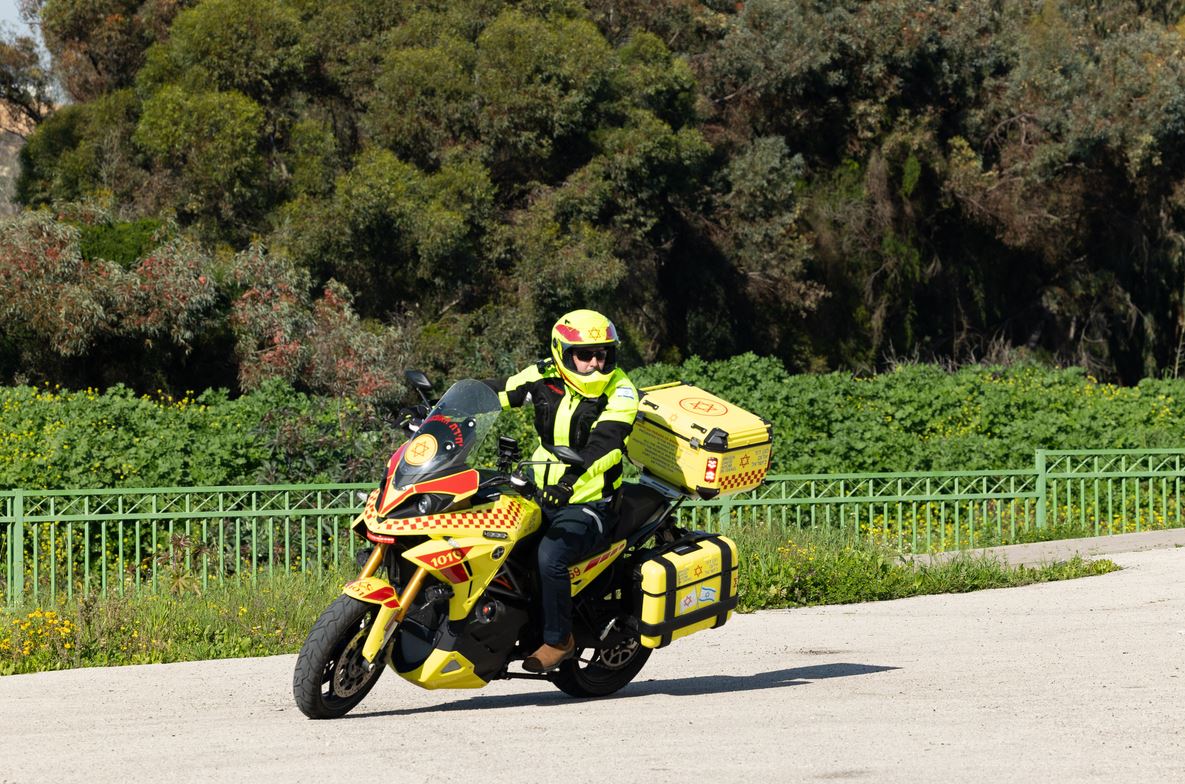
ALS Motorcycle
Response time is one of the most influential factors on the ability to save lives, especially in cases of respiratory obstruction, massive hemorrhage or lethal arrhythmias.
Short response time to begin the advanced medical treatment allows to utilize the organization's resources more effectively, reach the patient immediately and provide the patient with treatment given by an experienced paramedic. In many cases, the paramedic may also join the ambulance during evacuation, hence turning even a standard ambulance into a basic Mobile Intensive Care Unit.
Ambulances and Other Basic Life Support Vehicles
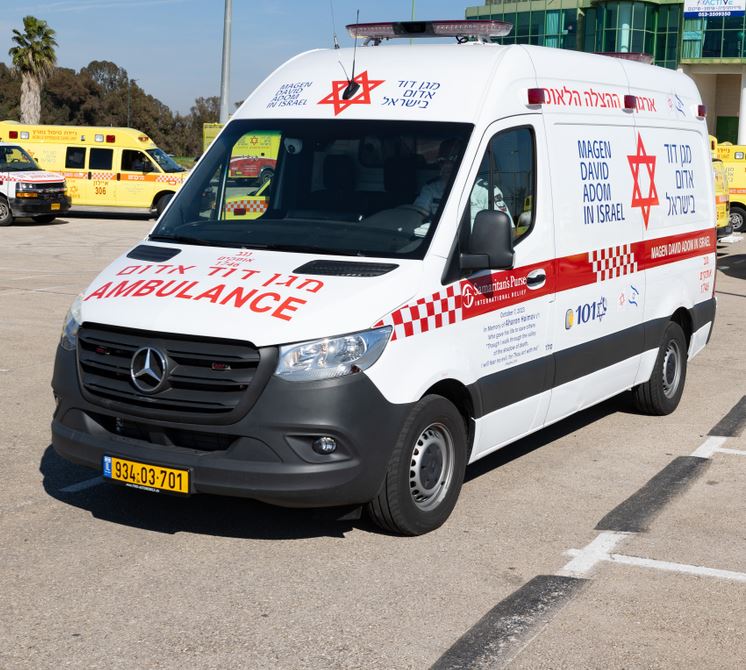
Standard (white) Ambulance
This type of ambulance is operated by an emergency medical technician, who may be accompanied by another emergency medical technician, National Service volunteer or a first aid responder.
The ambulance is equipped with dressing and Basic Life Support (BLS) equipment, providing preliminary response to the wounded or sick individual until they are brought to the emergency room or until the MALSU arrives.
Ambulances of this type are also used for non-urgent transfers of patients who, because of limited mobility, cannot arrive on their own to the hospital.
Mass Casualty Response Unit
The MCRU is a portable equipment storage vehicle, with contains large quantities of first aid equipment. The MMCIU is dispatched to the field on Mass Casualty Incidents or as part of providing security to an event which is expected to be attended by many participants. For example, securing live performances, etc.
Front Command Vehicle
The Front Command Vehicle was especially crafted to meet MDA requirements, as the result of design and development by the MDA Special Projects Section. The Front Command Vehicle can be positioned at any point and serve as an independent Control Center, allowing control of MDA forces in the field, and providing assistance to the forces in order for them to reach injured individuals and render treatment for them as quickly as possible.
The FCV is equipped with sophisticated radio systems, computers, telephones, fax and additional means of command and control.
When the FCV is positioned, it activates its four stabilizing supports (2 in the front, 2 in the rear) and raises a 15 meter high mast, which is basically a camera and an antenna and also a mobile lamppost allowing the Front Command crew to light up the area in any direction they choose. The FCV is loaded with special systems that allow MDA forces to work freely in the field, enjoying the most advanced technology even on complicated scenes.
District Front Command Vehicle
The efficiency of handling large scale incidents depends on command and control capabilities. This is especially true in ongoing incidents such as mega mass casualty incidents, fires, aviation accidents, train accidents, prolonged rescue operations during wartime and earthquakes.
In order to have control over incidents of this type, MDA has equipped itself with three District Front Command Vehicles positioned in the north, south and center of Israel. The DFCV allows simultaneous operation of a Command and Control Center, a conference room and a communication center.
The DFCV has communication capabilities based on cellular systems, filming and remote control capabilities. It also the capability to provide power and communication infrastructure to MDA teams throughout Israel.
4X4 Ambulance
This ambulance is equipped with 4 wheel drive. It is dispatched to incidents which necessitate evacuation of injured individuals from areas inaccessible by standard ambulances (such as the seaside and unpaved roads).
ATV Ambulance
The ATV has two stretchers installed on board. The ATV Ambulance stands by on call duty at the station and is dispatched to incidents where it is necessary to evacuate injured individuals from areas inaccessible by standard ambulances (such as the seaside, unpaved roads and narrow passages).
Life Support Motorcycle
This Motorcycle is on call duty. It is operated by an employee/volunteer for quick access to incidents mainly through urban traffic jams. It carries equipment according to the operator's qualification: BLS for an emergency medicine technician, ALS for a paramedic.
The operator on call duty, drives the motorcycle around and is dispatched to provide aid in nearby incidents.
Club Car
This vehicle is especially designated for stadiums. It occasionally enables MDA teams to easily and quickly reach and evacuate injured soccer players on the grassy field, hence allowing MDA teams to provide better treatment to the injured players.
ATV Ambulance and Tomcar
Israel is characterized by a variety of geographical landscapes, including mountains, desert, the coastal plain and more. Israel has a relatively long Mediterranean coast and plenty of beaches. All these require all terrain rescue vehicles that can reach rough terrain landscapes in order to treat the injured and evacuate them to hospitals.
The ATV Ambulance is equipped as a MDA ambulance and positioned in MDA stations near public beaches and nature's tourist attractions.
Exceptional cases, especially in the mountains and in hiking trails, necessitate an all-terrain vehicle with maneuverability much higher than that of an ambulance which can travel on paved roads. For this purpose, MDA operates a handful of Tomcar vehicles.
T3 Vehicles
Mass events such as park performances, parades, demonstrations or even funerals are a huge challenge to the rescue forces, which are required to reach the injured individual through a large crowed, while immediately pinpointing the location of this individual.
For this purpose, MDA acquired small motorized vehicles, equipped with CPR and first aid equipment, which allow the crew member to stand 25 cm taller than the crowd, make his/her way to the injured individual and begin treatment until an evacuation team arrives.
Last update: 25/07/2024