MDA Emergency Dispatch Center: “We Give 200% of Ourselves to Save Lives”
At MDA’s National Emergency Dispatch Center, every call can mean the difference between life and death. During ongoing missile attacks, teams work around the clock to coordinate life-saving responses across Israel. Tzvi Kuperman, a shift commander and father of three, shares what it’s like to manage multiple emergency scenes simultaneously, even when one of them is at his own home
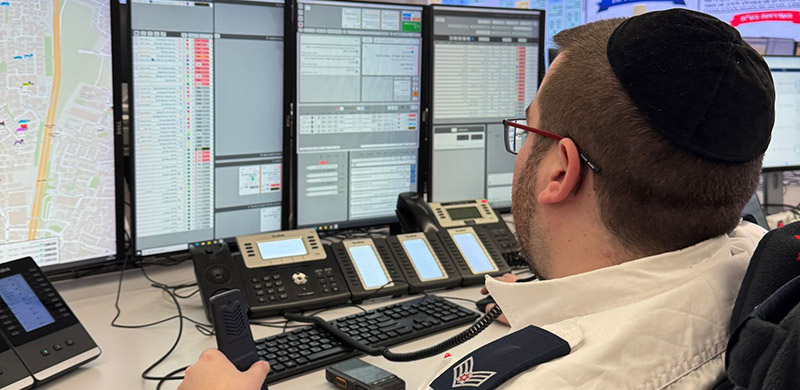
The MDA Emergency Dispatch Center is where everything begins, both in routine times and during emergencies. This is where emergency calls and reports from civilians and security forces are received, and from where MDA teams are automatically dispatched.
The MDA Emergency Dispatch Center is where everything begins, both in routine times and during emergencies. This is where emergency calls and reports from civilians and security forces are received, and from where MDA teams are automatically dispatched.
Using advanced technology developed within MDA based on operational experience and lessons learned in the field, the dispatch center’s teams, skilled EMTs and paramedics, create a real-time situational picture, coordinate the medical response at impact sites, and ensure that routine emergency calls continue to receive fast, high-quality, professional care despite the ongoing emergency.
This is the story of one man working at the center of the storm.
Tzvi Kuperman, 30, from Bnei Brak, is married to Shira and the father of three young children. He serves as a shift commander at MDA’s national emergency dispatch center. Like his colleagues, since the beginning of the operation he has been working 12-hour shifts.
“When we go home, we return to the reality of sirens in the evenings and at night,” he says. “After a few hours like that, we head back to the dispatch center again.”
“But all of us are on maximum alert and fully prepared. We understand the gravity of this moment and the responsibility placed on our shoulders, to make sure we provide the best possible medical response needed to save lives. Symbolically, on Purim they want to destroy us, and we’re here to stop their plan. Everyone here is giving 200% of themselves to save lives.”
“I texted my wife: update me that you're okay”
When a missile struck Tel Aviv on Saturday night (Feb. 28, 2026), Tzvi was on duty at the dispatch center, coordinating MDA’s response to several scenes simultaneously, one of them very close to his own home.
“When the missile struck Tel Aviv that Saturday night, there was also a report at the same time of a missile impact in Bnei Brak, right at my home address,” he recalls.
“My phone rang and it was my wife, while I was managing the response to an impact site. In a situation where every second can mean either life or death, my responsibility isn’t only to the residents who need MDA, it’s also to our crews in the field.”
“I didn’t answer. I texted her: ‘Update me that you’re okay.’ I breathed a quiet sigh of relief when she replied that she and the kids were in the sheltered room and unharmed. Later we found out it was a piece of shrapnel that hit a car right outside the building.”
“You can’t help but think — if something happens to them, it’s on me”
While Israeli civilians are instructed to remain in protected areas until the Home Front Command gives the all-clear, MDA crews continue operating in the field under the threat of missile fire, responding both to impact sites and to routine emergency calls.
At dangerous impact sites, crews search for casualties, assist with rescues from collapsed structures alongside Home Front Command rescue teams, and provide treatment and evacuation for those injured.
“On my screen I see every responder, every volunteer, every motorcycle unit, every ambulance, every team,” Tzvi explains. “The screen fills with dozens and dozens of markers around an impact site.”
“And the thought crosses your mind: if something happens to them, it’s on me.”
“It has happened before,” he recalls. “For example, during one of the missile impacts in a previous operation, a Mobile Intensive Care Unit was on its way to treat a woman who wasn’t feeling well. While they were driving, a siren sounded in Tel Aviv. The team, all women, by the way, had nowhere to take cover. Following Home Front Command instructions, they moved away from the ambulance and lay flat on the ground.”
“The missile impacted a few hundred meters away. The blast wave severely damaged the MICU and put it out of service. Thankfully, the incredible MDA team members survived and sustained only minor injuries thanks to their quick thinking and responsibility.”
“I salute the teams,” Tzvi says with deep appreciation. “Both the dispatch teams and the field crews who go out toward danger. I’m proud to be part of MDA, today and always.”